
Concrete Parking Lot Construction in Portland OR — Built for Heavy Traffic
Commercial concrete parking lots that handle Portland's truck traffic, weather, and drainage demands — from new lot construction to partial and full replacements.
- Locally Owned
- Free Estimates
- Commercial Grade
- Responsive Communication
What Does Concrete Parking Lot Construction Involve?
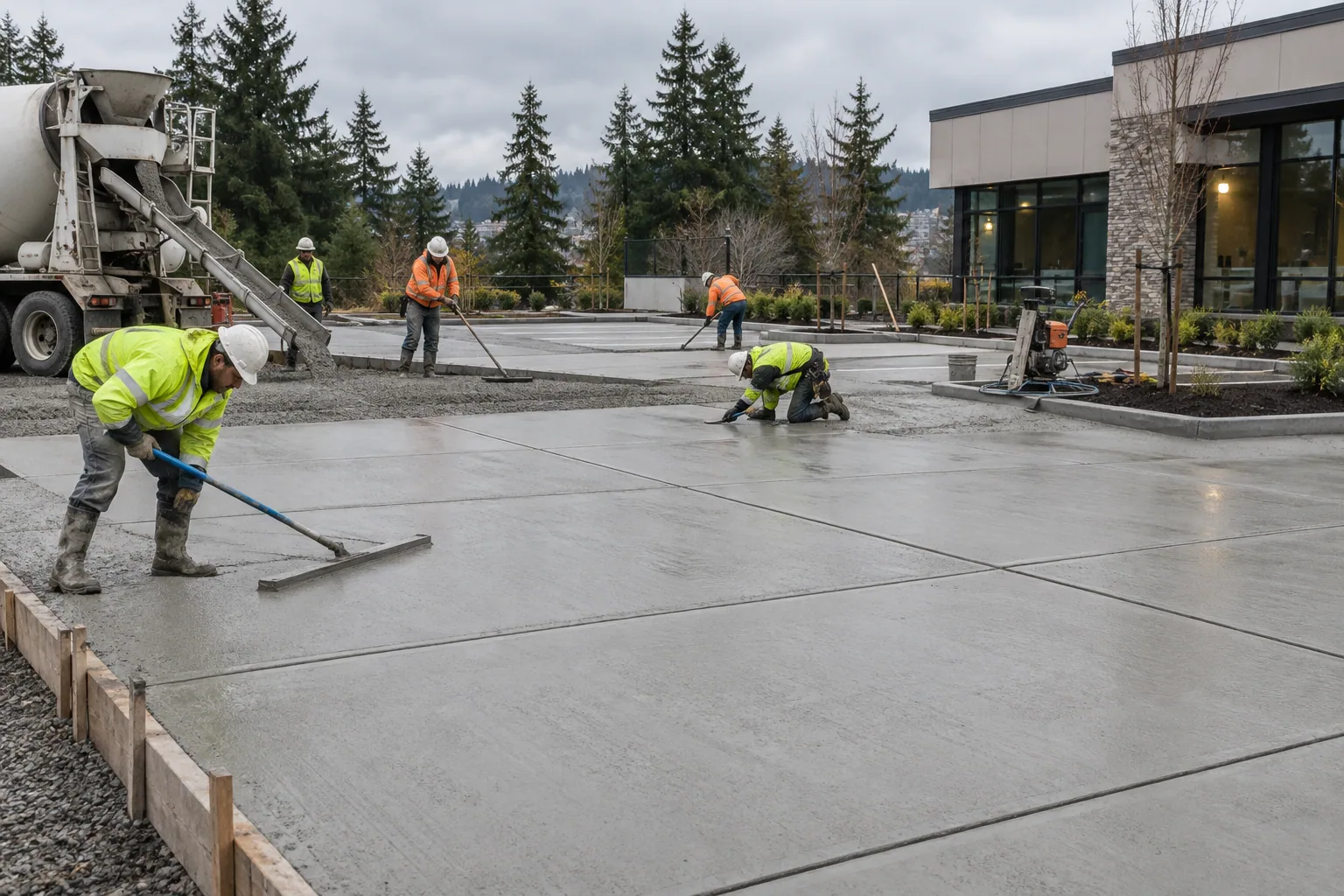
A concrete parking lot is a commercial-grade slab designed to support vehicle loads, manage stormwater, and withstand years of daily use. Unlike asphalt, which flexes and requires regular seal coating, concrete is rigid and maintains its surface profile for decades with minimal maintenance.
Construction begins with site grading and stormwater planning. Portland's stormwater regulations require parking lots to manage runoff — often through bioswales, catch basins, or permeable surfaces that reduce the load on the city's storm system. These requirements are factored into the lot design before any concrete is placed.
The subgrade is excavated, compacted, and covered with a compacted aggregate base. Forms are set for the perimeter and any internal grade transitions. The concrete is poured at a thickness appropriate for the expected vehicle loads — typically five to six inches for passenger vehicles and up to eight inches for truck and delivery traffic. Control joints are cut to manage cracking, and the surface is finished with a broom texture for traction.
When Does Your Parking Lot Need Work?
Wide Cracks Across Multiple Panels
When cracks extend through multiple panels or run diagonally across the lot, the base has likely failed beneath those sections. Panel replacement restores the structural integrity where needed.
Standing Water After Rain
Puddles that persist for hours after rain indicate grading issues. In Portland, where rain is frequent, poor drainage accelerates surface deterioration and creates liability from slip hazards.
ADA Non-Compliance
If your accessible parking spaces, ramps, and pathways do not meet current ADA standards, concrete modifications may be required. Settling, cracking, and surface deterioration near accessible spaces can trigger compliance issues during inspections.
Settled or Heaved Sections
Panels that have dropped or risen relative to adjacent sections create tripping hazards and vehicle clearance problems. Base failure — common in Portland's clay soils — is usually the cause.
Parking Lot Services We Provide
Concrete Parking Lots in Portland — Drainage and Regulations
Portland's stormwater management requirements affect every parking lot project. The city requires that new and substantially modified parking areas manage stormwater on site — either through detention, filtration, or infiltration. Bioswales, rain gardens, and permeable surfaces are common elements that we coordinate into the concrete layout.
The Central Eastside Industrial District, the Lloyd District, and commercial areas along 82nd Avenue and Sandy Boulevard see frequent parking lot work. Many of these properties have older asphalt lots that are being converted to concrete for longer service life and reduced maintenance. Concrete parking lots typically last 30 to 40 years versus 15 to 20 for asphalt in Portland's climate.
Portland also enforces ADA accessibility standards strictly. Every parking lot needs the correct number of accessible spaces, properly sloped ramps, and accessible routes to the building entrance. We verify these requirements during the planning stage so the concrete work meets compliance from day one.
What Happens During a Parking Lot Project?
Site Assessment and Planning
We survey the site, review drainage requirements, discuss traffic patterns, and coordinate with the civil engineer's stormwater plan. You receive a detailed estimate covering demolition, grading, concrete, and finishing.
Phased Construction
Most commercial parking lots are poured in phases so the business can maintain partial parking access during construction. We plan the phasing to minimize disruption to your operations.
Pour and Joint Cutting
Concrete is placed in panels with the correct thickness and slope for drainage. Control joints are cut within the specified timeframe to manage cracking. The surface is broom-finished for consistent vehicle and pedestrian traction.
Cure, Stripe, and Open
After adequate curing, the lot is striped with parking stalls, fire lanes, directional arrows, and ADA markings. Wheel stops or bollards are installed where specified. The lot is opened for use.
Need Parking Lot Work in Portland?
Start with a free site assessment. We evaluate the existing conditions, review drainage requirements, and provide a detailed estimate.
Why Portland Businesses Choose Us
Phased Work Planning
We plan the pour schedule so your business stays operational during construction. Partial lot closures are timed to minimize impact on your customers and operations.
Stormwater Compliance
We coordinate concrete work with Portland's stormwater requirements. Bioswales, catch basins, and drainage grading are built into the lot design from the start.
ADA Built In
Accessible spaces, ramps, and pathways are designed to meet current ADA standards. We verify slopes, widths, and surface requirements so the lot passes inspection.
Long-Term Value
Concrete parking lots cost more upfront than asphalt but last significantly longer with less maintenance. In Portland's climate, that durability translates to lower lifecycle costs.
Frequently Asked Questions
Concrete costs more initially but lasts 30 to 40 years versus 15 to 20 for asphalt. Concrete does not require seal coating, resists fuel and oil staining better, and holds up well in Portland's wet climate. For properties with heavy truck traffic, concrete's rigidity is a significant advantage.
Standard passenger vehicle lots are typically five to six inches thick. Areas that receive delivery truck or heavy vehicle traffic may require six to eight inches. The thickness is determined by the expected traffic loads and soil bearing capacity.
Yes. We plan phased construction to keep a portion of the parking lot open at all times. The phasing schedule is coordinated with you before work begins to minimize disruption to your business.
Portland requires parking lots to manage stormwater on site. This typically involves bioswales, planter strips, catch basins, or permeable surfaces. We coordinate the concrete layout with these stormwater elements so the lot meets code requirements.
Get Your Parking Lot Project Started
Call or submit a request to schedule a free site assessment. We evaluate the existing conditions and provide a detailed estimate.